News
Malaysia: Key Updates on Stamp Duty Relief & E-Invoicing
Summary
Malaysia’s IRBM has granted stamp duty relief for employment contracts signed before 1 January 2025, with stamping required by 31 December 2025 for contracts signed during 2025. Self-assessment for stamp duty begins 1 January 2026. From that date, consolidated e-invoices are banned for transactions over RM10,000, though allowed until end-2025 unless transaction-specific e-invoices are required. The e-invoicing exemption threshold rises to RM500,000, with a 6-month deferral for businesses earning ≤ RM5 million. Phased e-invoicing starts in August 2024, with full rollout by 2027 based on revenue size.
Content
- Stamp Duty Relief for Employment Contracts
- Employment contracts signed before 1 January 2025 are exempt from stamp duty.
- The relief does not explicitly extend to other agreements like service or intragroup service agreements; businesses should carefully review these in light of increased IRBM scrutiny.
- For employment contracts signed during 2025, businesses have until 31 December 2025 to comply with stamping requirements.
- Companies should assess associated employment documents (e.g., increment letters) for stamp duty obligations under the Stamp Act 1949.
- Self-Assessment for Stamp Duty takes effect from 1 January 2026, so a broad compliance review is recommended beyond just employment contracts.
- Restriction on Consolidated e-Invoices
- Consolidated e-Invoices (which require less buyer data) are banned for transactions over RM10,000 starting 1 January 2026.
- Until 31 December 2025, consolidated e-Invoices remain permitted for transactions above RM10,000, except where transaction-specific e-Invoices are mandatory (e.g., motor vehicle sales, flight tickets, private charters, construction, and related materials).
- e-Invoicing Deferral and Exemptions
- The revenue threshold for exemption from e-Invoicing increases from RM150,000 to RM500,000, applicable to both incorporated and unincorporated businesses.
- If a payee is an individual not conducting business, payers must issue a Self-Billed e-Invoice (SBeI), regardless of income level.
- The e-Invoicing timeline for businesses with annual revenue ≤ RM5 million is delayed by six months.
- Updated e-Invoicing Timeline
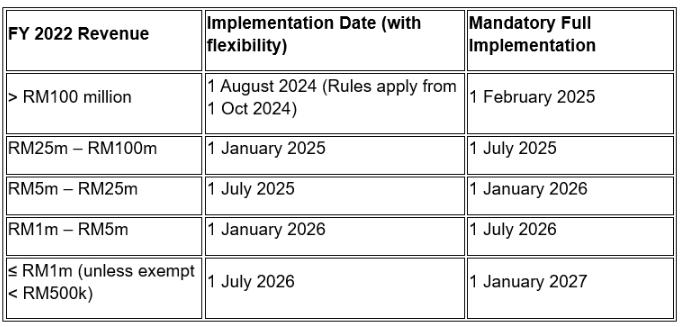
Notes:
- During the initial 6-month phase, consolidated e-Invoices are broadly permitted but non-compliance still triggers penalties.
- The RM500,000 exemption threshold is assessed annually. If crossed, e-Invoicing applies from Year 3.
- Group companies may be excluded from exemption.
- New businesses post-2022 follow a default start date of 1 July 2026, subject to exemptions.
Analysis:
- These updates signal IRBM’s stricter oversight on both stamp duty and digital tax reporting.
- Employers and businesses must conduct comprehensive reviews, especially regarding contracts, group structures, and transaction values.
- The phased e-Invoicing rollout provides flexibility, but businesses should not delay preparations given penalties still apply during transition periods.
- Particular attention is required for fragmented payments, individual recipients, and ensuring proper issuance of SBeI where needed.
Comments
Questions and comments (0)
There are no comments on this news yet.